
Tracking the bittern's deep boom in the marshes by the Pamet
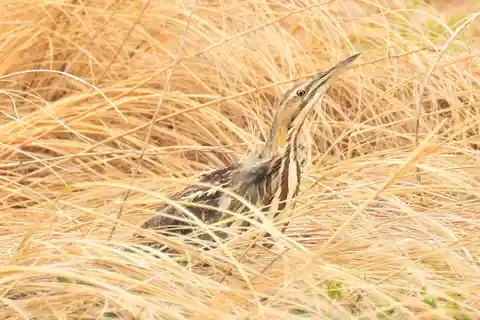
I knew that some people would hear it, that strange, deep, bubbling bounce of a rare marsh bird with perhaps some of the greatest nicknames of all time: Bog Bull, Thunder Pumper, Mire Drum, and Butterbump. I certainly wanted to. So, there I was, sitting stock still next to the Pamet River in search of a sound rather than a sighting.
The marsh was thick with grasses, trunks, and briars and the air teeming with the morning cacophony of the spring chorus, which included peepers, red-winged blackbirds, blue jays, robins, and cedar waxwings. And then I heard it, its decibels low but unmistakable, a sound like somebody was cranking the wheel of a water whistle with a malfunction.
"Plunk-alunk," it went. Then a 15-second pause and repeat: plunk-alunk. My Merlin app, the bird identification tool created by the Cornell Lab, picked up the call and put a red dot beside it. This was a rare find.
Botaurus lentiginosus is the Latin name for our American bittern. Very few people ever see this bird. It's scarcer now in part because of habitat loss, but I'd been feeling some hope about it. I'd seen in early flyers put out by the Friends of Herring River that the American bittern was featured as a species whose declining breeding habitat would be rehabilitated if the river were to be restored to its natural course.
Then, in November 2024, an ornithology professor who was living in my grandfather Jack Hall's house on Bound Brook Island astonished me with a note saying that he'd seen an American bittern walking on the lawn outside the kitchen window. In all my years, even in all my mother's father's years, on Bound Brook Island, no such sighting had ever been recorded.
Its vocalizations are strange. Observers have described how, in making them, the bird appears to be trying to remove an obstacle from its long throat. It clicks its bill, raises its open beak, then quickly draws it down as if swallowing a bubble of air to produce a resonant drumming, like drops hitting a pool of water.
The 19th-century French-born North American artist and ornithologist John James Audubon is said to have never heard its call. This I'm sure is because the decibel level is so low that many predators cannot pick it up. Many birds' calls can be nearly undetectable that way -- members of the grouse family for one. Given that J.J. Audubon bragged of killing hundreds of those birds, it's probably a good thing he couldn't hear the bittern's call.
I've always wondered why our bittern was so named rather than being lumped in with the more common names for birds within its family, Ardeidae, which includes the herons and egrets. I've found that the name seems to go back to the Gallo-Roman butitaurus, a mythical creature resembling a cross between a buzzard and a bull. I'm also finding that the French name for the bird, butor, besides referring to bitterns is also used to describe someone clumsy.
But Henry David Thoreau referred to the bittern as the genius of the bog. Adept at concealment, residing where few can travel, stealthily hunting in the ooze and shallow water's edge and thriving in the thick marsh vegetation to woo a mate and raise its young, this bird reflected those wild lands off the path of human imprint. "We need the tonic of the Wildness," he wrote, "to wade sometimes in marshes where the bittern and the meadow-hen lurk."
I meandered stealthily along the bank, back and forth, in hopes I might catch a bit of movement. But these birds were elusive even before habitat loss made sightings rare. They're well camouflaged in a wet marshy setting, the tan streaks on their long white throats resembling last year's reeds. Its head reveals binocular vision that allows it to clearly make out an intruder's size and distance from far away. If a bittern sees you coming, it stays still and raises its bill high in the air, resembling a reed even more. And, let's be honest, its preferred habitat isn't a place your average American hangs out.
I never laid eyes on the bird I heard that morning. But it was enough to know it was within 50 feet of where I was, happy in its soggy bog, looking for a mate, and maybe finding company to continue another cycle of life for this secretive species.

At least 655 pigeons shot at London Tube stations during a cull
The seven-year-old behind the viral bird calls reveals what's next
What a trip to the Falklands taught me about penguins
One simple change will keep small birds coming to your birdbath all summer
Pigeons cracked a problem built to defeat rule-followers, and it says something about AI

Florence County Library brings in an exotic animal rescue