
Pigeons cracked a problem built to defeat rule-followers, and it says something about AI
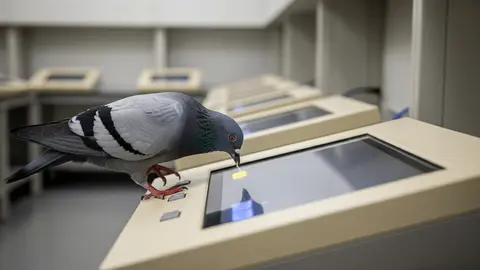
Most people shoo pigeons off park benches without a second thought.
That might change after hearing what a bird pecking buttons in a University of Iowa lab has revealed about the engine powering modern AI.
The connection is real, it is sourced, and it is almost impossible to believe until you look at the numbers.
The bird that most people write off as flying garbage
The pigeon has a reputation problem."Bird-brained" is an insult, not a compliment, and the city pigeon is usually cast as the least impressive creature on the block.
But more than fifty years ago, a psychologist at the University of Iowa started watching them very carefully, and what he found has never quite let go of him.
Edward Wasserman has been studying and teaching psychology at the University of Iowa since 1972 , and his lab has produced results that have unsettled animal intelligence research for decades.
The pigeon, it turns out, is a much stranger and more capable animal than its street-corner reputation suggests.
A test so hard that no rules could crack itWasserman's team devised a "diabolically difficult" test, as he calls it, in which each pigeon was shown a stimulus and had to decide, by pecking a button on the right or on the left, which category it belonged to.
Categories differed by characteristics including line width, line angle, and concentric or sectioned rings, with stimuli the pigeons had never encountered before.
A correct answer yielded a tasty pellet; an incorrect response yielded nothing.
What made the test so demanding was its arbitrariness: declarative learning, exercising reason based on a set of rules or strategies, could not help. Only associative learning, the process of recognizing and making connections between objects or patterns, could get the job done.
No shortcuts existed.Initially, the test pigeons were correct around half of the time, though after many hundreds of tests and the incentive of a tasty reward, they eventually reached an average of 68 percent accuracy.
Wasserman puts it plainly: "You hear all the time about the wonders of AI, all the amazing things that it can do. It can beat the pants off people playing chess, or at any video game, for that matter. It can beat us at all kinds of things. How does it do it? Is it smart? No, it's using the same system or an equivalent system to what the pigeon is using here."
Read that again.What the pigeon is actually doing inside its small grey head
University of Iowa researchers concluded that pigeons use the same base learning principle, called associative learning, as artificial intelligence.
Associative learning is the process of connecting an action to an outcome through pure repetition: do a thing, get a reward, remember it, refine it.
By subjecting pigeons to complex categorization tests, the birds were able to reach nearly 70 percent accuracy through repetitive, trial-and-error learning, the same form of associative learning, where connections are made between objects or patterns, that is also utilized by AI systems.
Wasserman argues that pigeon behavior suggests nature has created an algorithm that is highly effective at learning very challenging tasks, not necessarily with great speed, but with great consistency.
That consistency, it turns out, is exactly what the engineers building today's most powerful enterprise AI models are chasing.
And the data those systems train on matters enormously, just as the value of everyday human-generated text has shown the industry.
The reveal: this is literally how many of the world's most advanced AI systems work
The University of Iowa's own research confirms that pigeons use the same basic learning process as AI, and that the relationship between actions, consequences, and learning that emerged from pigeon studies serves as the core of many AI applications today, particularly within reinforcement learning.
Although early work with pigeons lost traction in psychological research during the 1960s, its principles found new life in computer science.
The relationship between actions, consequences, and learning that emerged serves as the core of many AI applications today, particularly within reinforcement learning.
Today, reinforcement learning fuels remarkable innovations, from self-driving cars to AI systems that play complex strategy games.
The human-sounding breakthroughs coming out of Silicon Valley labs every few months are running, at their base level, on the same algorithm a pigeon uses to figure out which button earns it lunch.
As Wasserman has observed, there is a striking paradox at the heart of this: "People are wowed by AI doing amazing things using a learning algorithm much like the pigeon," yet when associative learning is discussed in humans and animals, "it is discounted as rigid and unsophisticated."
And then there is the medical scan detail, which is almost too strange to print.
In a landmark 2015 study published in PLOS ONE, a team led by pathologist Richard Levenson at UC Davis, with Wasserman as co-author, trained pigeons to detect cancerous breast tissue in medical scans. The pigeons learned in only a matter of hours to do better than random at distinguishing cancerous from noncancerous cells, and over the course of about a month their accuracy rose as high as 80 percent. Far more impressive was the wisdom of the flock: by combining the judgments of multiple birds, accuracy rose to 99 percent, on par with trained human experts.
Why this changes how engineers think about intelligence itself
The recent accomplishments of AI are prompting some researchers to rethink the role of associative learning, a process largely dismissed as too simplistic to produce complex behaviors in animals, yet celebrated for producing human-like behaviors in computers. Scientists studying animal cognition call this the "associative learning paradox," and it is cracking open in both directions at once.
The pigeon gets a long-overdue upgrade in status, and AI researchers get a clearer picture of why their systems work.
Together, studies of pigeon cognition have revealed the bird to be a prodigious classifier of both naturalistic and artificial visual stimuli, and new computational models suggest that elementary associative learning lies at the root of the pigeon's category learning and generalization.
None of this makes the pigeon on your fire escape a genius.
But the next time a language model writes something that surprises you, the honest answer to how it learned may trace back not to a supercomputer, but to a small grey bird pecking a button for a pellet of food in Iowa City.

At least 655 pigeons shot at London Tube stations during a cull
The seven-year-old behind the viral bird calls reveals what's next

What a trip to the Falklands taught me about penguins

One simple change will keep small birds coming to your birdbath all summer

Florence County Library brings in an exotic animal rescue
Point Defiance Zoo closes its puffin habitat after three birds die