
The Rockefeller refuge fights for its waterfowl, and for itself
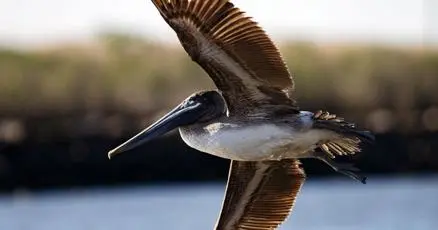
An American coot skips across the water Tuesday, March 17, 2026, at Rockefeller Wildlife Refuge in Grand Chenier, La.
Scooter Trosclair punches his airboat through a soil patch into an opening of brackish marsh. As the boat cuts through bitter cold-front air, there's an eruption of fluttering wings. He's gliding through Rockefeller Refuge, 26.5 miles of protected Gulf coastline in Cameron Parish, that during the winter, becomes one of the state's densest waterfowl populations -- home to around 200,000 ducks, geese and coots.
It's mid-March, and the chorus of quacks is small compared to a few months before. Most of the mallards, pintails, white-fronted geese and snow geese have gone north for spring, though many blue-winged teal, mottled, and black-bellied whistling ducks remain.
"Usually this whole flat, the sky will be black," said Trosclair. "January, December, you couldn't put another bird in here."
Among Trosclair's most daunting tasks as the Rockefeller program manager is protecting it from coastal erosion and land loss. Since the 1910s, when Tabasco heir E.A. McIlhenny purchased the land and sold it to the Rockefeller Foundation, the refuge has lost more than 15,000 acres to the Gulf.
Trosclair, 50, grew up in surrounding Grand Chenier. He began working on the refuge in high school and has seen the area devastated by hurricanes: Rita in 2005, Ike in 2008, and Laura in 2020. With each storm, fewer people return, and most of the properties around the refuge are now hunting camps. His own employees have lost their homes three times in the past 15 years. With the nearest grocery store an hour away, it's harder for him to find employees to work in the remote area.
"We lost our applicant pool," he said. "You also lost the talent of people from here that understood the nature of the beast, of how to manage this stuff."
Beyond protecting wetlands, Trosclair and a small team of dedicated biologists conduct some of the most extensive waterfowl research in the world. It's led by biologist Paul Link, a 45-year-old North Dakotan, who has spent most of his life following the birds up and down North America -- either in person or by GPS tracking devices. During his four years on Rockefeller, Link estimates he's tagged at least 45,000 ducks and geese on the refuge and surrounding rice farms.
By studying their long-term movements, Link and his team are trying to answer why so many waterfowl populations massively fluctuate, in a state with over a $100 million hunting industry revolving around them. According to aerial surveys conducted by the Louisiana Department of Wildlife and Fisheries, the population of waterfowl has bounced between 2 million in Louisiana in the 1980s to 5 million by the turn of the century, back to a low of 2 million over the last decade.
While overall duck populations are 24% higher in North America than they were in 1970, many of those species are on a steep decline, including mallards, northern pintails and blue-winged teals, whose breeding grounds to the north are losing habitat. Meanwhile, mottled ducks, a staple in Louisiana year-round, are threatened by the state's deteriorating marshes.
While Link says his research could help identify ways to mitigate some of those factors, he says the answer to keeping ducks coming back to Louisiana will remain the same.
"It's simply habitat," Link said. "The more of it, the higher quality we can provide, the more will come."
Follow the tealMost ducks and geese treat Rockefeller as a bedroom. They sleep there during the day, then fly to rice and crawfish farms to feed at night; during hunting season, they usually head back to safety before shotgun shells hit the chamber. Blue-winged teal are different, feeding during the day and staying longer than most into the spring, said Link.
On a grassy bank near headquarters, Link steps into shallow water and dumps a bucket of rice. It's late morning, and nearby teal eye the bait. Later, with volunteers, he'll time the feedings with attempts to attach transmitters that track the birds' little-studied migration routes, which span from upper South America to Alberta, Canada. The devices use satellites to collect their locations every 30 minutes and track their movement every 6 minutes, then send all this data back to Link and his graduate students via cellular networks.
By following their paths and recovering birds that go silent, Link hopes to pinpoint what's killing them.
Since 2012, blue-wing teal's breeding population in North America has dropped from its peak of 9.2 million to around 4 million, according to Ducks Unlimited, a waterfowl conservation group. That forced Louisiana to shorten its teal hunting season last year from 16 to 9 days for the first time in decades.
Because teal constantly travel great distances, they're among the highest carriers of avian flu, and Rockefeller partners with the University of Georgia's Southeastern Cooperative Wildlife Disease Studies (SCWDS) to collect saliva and blood samples that are tested for the virus. Some samples are sent to St. Jude's Children's Research Hospital to develop human vaccines.
Link says the disease has spread more rapidly as habitat disappears and birds crowd into smaller remaining wetlands.
Should hunters be worried?This year's duck hunting season was a good one for Jeff Deblieux in coastal Louisiana. November cold fronts and drought conditions in northern Louisiana and Arkansas pushed larger numbers south to the coast. At 64, Deblieux has duck-hunted all his life, and he's not too concerned about overall declining numbers, mainly because he's seen it before.
"We hope we're on the bottom of that cycle, and eventually it's going to come back up," he said.
Jason Olszak, waterfowl program manager for LDWF, felt the same.
"We've been here before," said Olszak. "I'm not super pessimistic about anything other than the breeding grounds."
Olszak, Link and most ecologists agree the primary threat to waterfowl comes less from the loss of coastal marshland than from recent droughts and habitat loss in the Prairie Pothole region, which spans from Iowa through the Dakotas into Saskatchewan and Alberta, where 70% of North America's waterfowl breed. Increasingly, the land is being converted to oil and gas development and row-crop farmland.
"It has all been dependent on the wetness of the prairies," said Olszak, referring to duck numbers. "A confounding factor is the fact that they continue to convert those native grasslands into row crops."
With fewer birds coming from the north, Olszak said there's actually a surplus of habitat for ducks in Louisiana. But he, Link and Deblieux all agree -- to varying degrees -- that changes to Louisiana's habitat quality still matter. Invasive plant species like salvinia and water hyacinth crowd out vegetation ducks rely on for winter feeding, while saltwater intrusion -- worsened during hurricane years -- kills much of the rest.
In Louisiana, wintering ducks actually rely on agriculture, particularly rice farms. But many have been replaced by sugarcane fields. With increased harvest efficiency and herbicide use, Link says those that remain leave little for ducks to fatten up on, while transitions to more level rice fields expose the birds to more predators. Add in the fact that Louisiana is regularly in the top three states for duck harvests, and the cumulative stress shows.
Link compared two white-fronted geese he's tracked among 297 females -- part of the largest waterfowl movement study in the world. One wintered in central Illinois, the other in Louisiana. The Louisiana bird slept barely 10 hours total over two weeks. The Illinois bird snoozed 10 hours nightly over the same period.
"You're cracked out, you can't even think straight trying to stay alive," he said of the Louisiana bird.
"In Louisiana, we're seeing that we're having lower breeding propensity, lower fecundity, lower success for our birds," Link added. "They are at a terrible disadvantage."
Louisiana ducks also face much longer migration flights back north, made harder to time by increasingly erratic weather patterns. Mistime that flight, said Link, and birds return to a barren wasteland. He's baffled they still come to the state in the numbers they do. Many are simply programmed to fly over better wintering spots for the reliable wetland habitat.
His studies aim to pinpoint exactly how Louisiana can do its part in improving conditions and understand how bird behavior is changing.
"They want to come here," said Link. "If we did a better job taking care of the habitats here, they'd have better survival when they come back home during the spring."
Limestone, levees and LNGTrosclair and his staff maintain more than 50 water control structures to regulate water and salinity levels for vegetation, along with 200 miles of levees and a loch structure to keep saltwater inundation at bay.
As Trosclair whips the airboat through the marsh, dump trucks haul sediment to rebuild an old levee since overtaken by the tide. He points to a 5.5-mile limestone barrier, fully completed on the beach in 2023. The rocks help retain sediment pushed in by waves and new land began forming there within months. Oyster grass now grows where there was once open water.
The structure -- which Trosclair is working to secure funding to extend another 4.5 miles -- has already attracted droves of fish and crustaceans. Near the barrier, a pair of dolphins breaches the surface.
Overall, $344 million is being spent on current projects to preserve the refuge, cobbled together from federal, state and local governments, conservation groups like Ducks Unlimited, and private companies, including the liquefied natural gas industry that has boomed in the surrounding area.
Trosclair takes funding wherever he can find it and welcomes any industry that will bring people back to his home.
"If you don't have people here, there is no one concerned about the issues," he said. "The state doesn't have the money. There are higher priorities. You have to maintain the hospitals before you maintain the habitat for ducks."
But the money hasn't stopped Rockefeller's fundamental challenge -- at least not yet. The refuge loses 50 to 100 feet of marsh annually, with some areas losing up to 300 feet, Trosclair said. That poses dangers beyond waterfowl. Just 900 feet to the north lies La. 82. Past that, hundreds of thousands of acres of agricultural fields.
"All this marsh is entangled in so many different livelihoods, but it's all related to culture, what we eat, what we produce, even how we act," he said. "But you're working against the forces of nature in the Gulf."

At least 655 pigeons shot at London Tube stations during a cull
The seven-year-old behind the viral bird calls reveals what's next
What a trip to the Falklands taught me about penguins
One simple change will keep small birds coming to your birdbath all summer
Pigeons cracked a problem built to defeat rule-followers, and it says something about AI

Florence County Library brings in an exotic animal rescue