
2,000 steppe eagles flock to Rajasthan, and scientists are worried
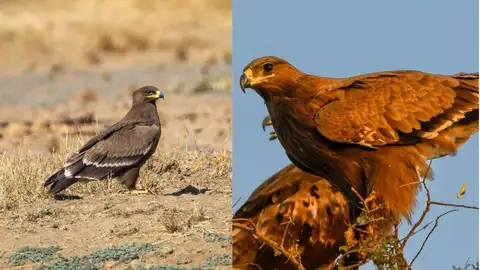
Rajasthan's refuge may not sustain rising eagle numbers long-term.
In a striking development, western Rajasthan is now being seen as a major stronghold for the endangered Steppe Eagle. These large migratory birds, once spread widely across Central Asia, are now increasingly gathering in India's desert landscapes during winter.
Region's Jorbeer Conservation Reserve and Desert National Park in India conducted a survey in which 2,000 Steppe Eagles were recorded in Rajasthan. But this eagle gathering is worrying scientists.
A Long Journey ends in IndiaThe Steppe Eagle breeds in regions like Kazakhstan and southern Russia. Every year, it travels thousands of kilometers to warmer areas. Now many of them are choosing Rajasthan as their winter home. This area, with its open spaces, closely resembles their natural habitat, which is a type of steppe environment, making it a great place for resting and feeding.
The 2,000 Eagles Gathering: An Unusual EventFor a bird species like the Steppe Eagle, a large number of birds in a particular region is uncommon, as these birds are usually scattered over a large area during migration. The growing number of Steppe Eagles in Rajasthan may look like a success story, but in reality, it signals on shrinking of habitats of endangered species.
At first glance, this sounds like a conservation success. But scientists said it is actually a red flag. The increasing concentration of Steppe Eagle in Rajasthan may mean that their habitats elsewhere are shrinking or degrading. They are being forced into fewer safe zones. Scientists also underlined that their global population is declining rapidly.
What attracts these rare eagles to Rajasthan?
Western Rajasthan offers abundant food like carrion and waste dumps with wide and open landscapes. This region has fewer disturbances compared to other regions. These conditions make it one of the last reliable wintering grounds for the species.
Can Rajasthan sustain this surge?While Rajasthan is currently acting as a refuge, experts warn it may not be enough in the long run. A sudden rise in eagle numbers can lead to increased competition for food. Higher exposure to threats like power lines and toxins could be a big problem. If conservation efforts do not scale up, even this "safe haven" could become overwhelmed.

At least 655 pigeons shot at London Tube stations during a cull

The seven-year-old behind the viral bird calls reveals what's next

What a trip to the Falklands taught me about penguins

One simple change will keep small birds coming to your birdbath all summer

Pigeons cracked a problem built to defeat rule-followers, and it says something about AI

Florence County Library brings in an exotic animal rescue