
The North Sea's top predators are going after the same prey
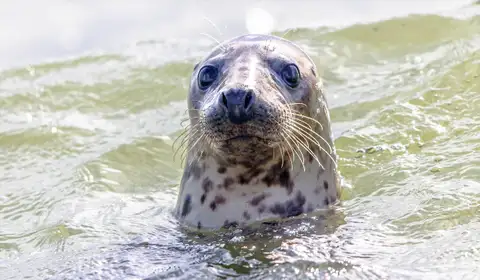
Top predators don't usually compete for prey. In the North Sea, harbor porpoises and gray seals do not even look like close competitors.
One is a small, shy cetacean rarely longer than five feet (1.5 meters). The other is a burly, scarred pinniped that can push 400 pounds (180 kilograms). Different bodies tend to mean different diets.
A new study finds that assumption is crumbling. Chemical traces in muscle tissue show the two species share more dietary territory than expected. As gray seal numbers grow, porpoises seem to be losing access to their highest-energy prey.
The southern North Sea is fish-rich and crowded with harbor porpoises, harbor seals, and gray seals. All these predators hunt the same shallow grounds and compete for the same fish species.
Eileen Heße, a marine ecologist at the Institute for Terrestrial and Aquatic Wildlife Research (ITAW) at the University of Veterinary Medicine Hannover, led the team. Earlier work had compared the two seal species; no one had brought all three together.
For this study, Heße and colleagues pulled samples spanning nearly three decades. The dataset included hundreds of seal droppings from sandbanks and offshore islands alongside stomach contents from stranded animals.
Telling who ate what is harder than it sounds for animals that vanish under the waves. The team paired stomach content analysis with DNA extracted from droppings and intestines. This method is useful, but limited to the last meal or two.
To see what each animal ate over months, they turned to chemical fingerprints in muscle tissue. Carbon and nitrogen leave signatures reflecting a long dietary history. Not just the last meal. Researchers have tracked them in marine mammals for decades.
Heße's team added sulfur, a third element that distinguishes open-water feeding from foraging in sediment-rich coastal zones. That combination had never been applied to marine mammals in this region before.
Harbor and gray seals share roughly 71 percent of their fish prey, an unusually high overlap for two species that often haul out side by side.
Flatfish, bottom-dwelling roundfish, gobies, and sandeels dominated both diets. Porpoises matched each seal at around 45 percent.
Sandeels are small forage fish at the base of the food web. Across the wider region their populations have grown more fragile, with declines in body size documented in a recent study.
For all three species of predator, the most contested fish were in the same few groups. The predator species do not share menus completely, but where they do compete, they overlap on the most energy-rich items. That is the worst place to share.
Static numbers tell only part of the story. Between the early 2000s and 2021, the chemical signatures of porpoises and gray seals drifted noticeably closer together.
Their dietary fingerprints - chemical ratios in muscle tissue - began to overlap more. These ratios track both what an animal eats and where it forages. The overlap grew most where the two species had previously looked most different.
Harbor seals went the other way. Their niche actually shrank, and they showed a tighter, more specialized diet. Gray seals expanded their foraging footprint, large enough to contain the porpoises' entire dietary territory.
Porpoise stomachs delivered the most arresting pattern. Heße's team tallied how much energy-rich prey - sandeels, herring, oily fish - the porpoises had eaten over the years. They mapped those numbers against gray seal abundance during the same span.
The two lines moved in opposite directions. Bringing gray seal numbers into the analysis raised the model's predictive power from roughly four percent to nearly 18. The link held after accounting for sex, age, and seasonal swings.
As gray seal numbers rose, porpoise stomachs held less of the high-energy food. Whether that reflects direct competition or some broader change in prey availability, the data cannot say. The association is consistent and strong enough to warrant attention.
Gray seals are roughly three times the size of harbor seals and many times larger than porpoises. With that bulk comes range - they hunt a wider variety of prey and travel farther between feeding grounds.
Aggression also plays a role. Over the past decade, DNA evidence and direct observations confirmed what biologists once only suspected.
Gray seals actively hunt harbor seals and harbor porpoises. Sometimes they even hunt their own young.
A separate paper established that behavior through bite-mark analysis and gray seal DNA recovered from porpoise carcasses.
The behavior is no longer in doubt, though how often it happens varies by region and remains difficult to quantify.
Before this study, no team had analyzed all three predators with the same toolkit. Adding sulfur isotopes to the mix also provided something that previous work lacked: a clearer signal of where each animal actually fed.
Porpoise numbers in the southern North Sea have been falling. Harbor seals have struggled with disease outbreaks.
Both species now have a new factor to weigh - a recovering dominant predator that increasingly overlaps with their diet and foraging habitat.
There are also other forces at play. Climate change is reshuffling fish communities and fishing pressure adds stress.
Separating competition from prey collapse is the next job - and managers can no longer treat the three as separate problems.
Like what you read? Subscribe to our newsletter for engaging articles, exclusive content, and the latest updates.