
Fossils reveal the sexes of a 450-million-year-old species
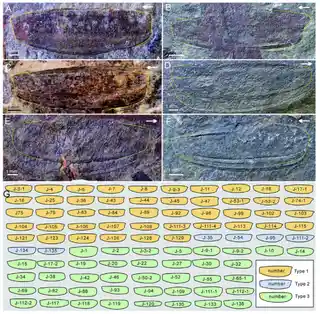
Sexual dimorphism is the concept that the male and female counterparts of the same species have differing morphologies. Whilst it may be easy to tell the difference in extant organisms, how can you differentiate sex when you have flattened shells that are almost half a billion years old? In their latest paper in Paleobiology, Yilong Liu and colleagues tackle exactly that. The authors target a tiny, shrimp-like marine arthropod called Soomicaris ordosensis, that lived during the Late Ordovician in China around 450 million years ago. These animals belonged to a group known as phyllocarids, which diversified during this time, and are early relatives of modern crustaceans e.g., shrimps and crabs.
In the fossil record, these creatures tend to only be preserved as their carapace, a shell that once covered their body, now flattened overtime in fine-grained sedimentary rocks. As with much of the fossil record, the soft tissues, appendages, and reproductive organs, often useful in systematics, are almost never preserved. Liu et al. (2026) uses mathematics to show that even without these rarely preserved body parts, carapaces can still inform us of reproductive biology.
The research team examined more than 150 fossil carapaces from Upper Ordovician rocks in northern China, selecting 92 well-preserved specimens for detailed analysis. At first glance, the shells seemed to fall into three types. On one end of the spectrum, specimens had a sharp, backward-pointing spine on the upper rear margin. On the other end, specimens had a smooth, rounded back edge. Few specimens fell between these end members. Traditionally, palaeontologists might measure length, height, and ratios between them to test whether these forms represent distinct species. However, these simpler measurements can miss subtle differences in overall shape, especially when the fossils have been altered by millions of years of burial.
Instead, Liu and colleagues used a technique called elliptic Fourier analysis, a special type of geometric morphometrics. They digitally traced the outlines of each shell and converted those curves into mathematical descriptors. A statistical method called Principal Component Analysis was then applied to identify patterns in shape variation across the sample. Interestingly, the fossils clustered into two robust groups, as opposed to three distinct species as suggested by initial observation. One group had a pronounced posterodorsal spine; the other had a convex, spineless rear margin. The mysterious 'third' type was simply a minor variation within the spined group. Conveniently, both forms occurred in nearly equal numbers. The question then remained - could they represent different species? Environmental variants? Or sexual dimorphism?
The authors quickly ruled out ecological explanations. The fossils came from the same sedimentary layers and show no evidence of environmental shifts that may drive shape changes. The two forms also share nearly identical features along the front of their shell, suggesting they were, in fact, the same species. That indeed leaves sexual dimorphism as a strong explanation for the morphological groupings.
In many living crustaceans, females have slightly expanded or modified carapaces to brood eggs beneath them. Modern phyllocarids, such as species of Nebalia, carry their eggs under the carapace, supported by specialised appendages. In these species, females have more rounder, spacious shells. This may be what we see in fossil Soomicaris - a more rounded shell may have accommodated egg brooding. Secondly, the near-equal ratio between morphotypes suggests a simple mating system with separate individual sexes, known as dioecy, much like most modern animals. In fossil crustaceans, sex ratios can sometimes reveal whether species reproduced through dioecy, hermaphroditism (an organism with both male and female reproductive organs), or even parthenogenesis (a form of asexual reproduction).
If the author's suggestion is correct, these fossils would represent the first indirect evidence of reproductive behaviour in an extinct order of phyllocarids known as archaeostracans. This study also demonstrates that even when only hard parts survive, careful quantitative analysis can reveal aspects of behaviour, development, and reproduction in ancient organisms.