
Camp Danger introduces kids to spiders, pocket dragons and Vlad the Impaler
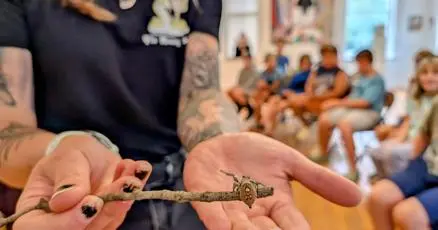
Youngsters at VAE's Camp Danger were introduced to Sydney, a Florida-bred jumping spider roughly the size of a half dollar (by hobbyist measurements) and, by Raven's account, about as dangerous.
NORTH BENNINGTON -- At The Left Bank Gallery on Wednesday, a roomful of youngsters learned two key rules of life. Number one: anything with a mouth can bite. Number two, anything with a butt can poop. Everything else was in the details.
On Wednesday, those details - about spiders, snakes, scorpions, and one very opinionated millipede - were delivered courtesy of Opal Raven, an animal educator whose traveling menagerie was the star attraction at Camp Danger, a one-week summer program run by the Vermont Arts Exchange (VAE).
Due to the weather, the camp took refuge at The Left Bank Gallery in North Bennington for the presentation, and VAE director Matthew Perry was juggling art, jokes, kids, and at least one albino boa constrictor.
Before the animals came out, Perry walked campers through the current exhibit, built around the many meanings of the word "draw" - from drawing a picture to drawing a gun. His own piece reimagines a "Gunsmoke" saloon shootout, with a card game gone bad and a bar full of half-finished figures that visitors to the gallery were invited to complete.
Then, he turned the floor over to someone equipped not with a paintbrush, but with a temperamental and twitchy emperor scorpion named Vlad the Impaler.
"In Camp Danger, there are kids that are doing things for the first time in their life, things that are somewhat dangerous, or [that] they're not allowed to do," Perry said, as the youngsters leaned in. "If we expose kids to things in appropriate ways, to do things and have fun and experiment, then we can avoid them getting hurt or something worse."
'Give me one of these - if you don't want a spider'
Raven introduced the presentation by assuring the youngsters that no animals would be launched at them. If anyone hated the idea of a spider within arm's reach, for example, they only had to cross their arms over their chest in a silent "nope" signal.
"No one is going to throw an animal onto you," she laughed, and then introduced Sydney, a Florida-bred jumping spider roughly the size of a half dollar (by hobbyist measurements) and, by Raven's account, about as dangerous.
Sydney is a true spider - she can spin webs - but prefers to jump on her dinner instead of waiting for it to fly in. Her venom, Raven explained, is powerful enough to turn a fly into soup but so mild that if she tried to bite a human, she'd mostly just bonk her face.
"If she tried to bite me, she'd probably just smush her face into me, and I wouldn't even know," Raven said, as Sydney rode calmly on her hand.
From there, Raven began to work her way up the food chain.
Meet Pennywise, gentle destroyer of rotting leaves
Next came Pennywise, an American pink-legged millipede with more legs than self-awareness. Campers guessed his diet - was it bugs? Meat? Souls?
Close. Pennywise eats dirt, rotting leaves, and decaying wood - and is a part of the compost crew of the animal kingdom. He literally poops out nutrient-rich fertilizer.
"These guys are decomposers," Raven said. "Without things like this, we wouldn't have the soil that grows the trees that can then house all the other animals."
Pennywise, she added, is a retired breeding millipede who now lives out his golden years in a box of gourmet soil, occasionally cruising up Raven's arm while children shriek (mostly in delight).
Aprilia, the 'pocket dragon,' and Michael Myers, the barb flinging tarantula
To prove that "dangerous-looking" doesn't always mean "dangerous," Raven brought out Aprilia, a red-eyed crocodile skink she calls her "pocket dragon."
Aprilia is an insectivore with heavy, armored scales and the permanent expression of a lizard who has seen things and would like to go home now, "A lot of these guys are more afraid of us than we are of them," Raven told the campers, grinning, and watched as they grinned back. And, judging by Aprilia's body language, Raven was speaking truth.
Next, it was time for Michael Myers - not the slasher, but a young male Brazilian black tarantula whose hobbies include looking intimidating and not actually hurting anyone.
Michael's venom, like Sydney's, is classed as "medically insignificant" for most people - on par with a bee sting. His real party trick is his urticating hairs, the tiny barbed bristles on his abdomen that he can flick like itchy confetti at anything that bothers him.
"They're just like, 'pew pew pew,'" Raven said, miming a tarantula butt-wiggle, and peels of laughter broke out. "It looks ridiculous, but you do not want it in your eyes," she added, grimacing comically.
Smog the albino boa and the silent hug of death
The room went noticeably quieter when Raven introduced Smog, a gentle albino boa constrictor and, as she put it, her "big performing snake." Apparently, Raven and Smog are dance partners - like, for real. In real life, Smog has a wife and they are expecting a family in the near future.
Smog's shed skin had already made the rounds, letting kids feel the ghost of his scales before meeting the real thing. In person, Smog was surprisingly mellow - more sleepy scarf than movie monster.
Raven used Smog to explain constriction - the silent "hug of death" that replaces venom in many snake species - and the mechanics of a semi-arboreal body built for both tree-branch balancing and ground travel. His belly scales, called belly scutes, help him hook onto surfaces and pull himself forward.
Smog, she said, has been trained not to wrap across the front of a handler's neck - a safety must when your coworker is one long muscle. And probably also a helpful trait when it came time to dance.
Walking campers through his feeding regimen - frozen-thawed rats, choreographed (using tongs) in what she calls the "zombie rat dance" so that Smog can strike, coil, and constrict without ever meeting a live rodent.
"I am not on the menu," Raven emphasized, laughing. "It was easier to train him that [way] than to convince him not to constrict."
Meet Vlad the Impaler and Bowser, the pajama gecko
When Raven announced Vlad the Impaler, the kids sat up straighter.
Vlad is an emperor scorpion - glossy black and just bristling with attitude. Vlad is, according to Raven, "probably" the most dangerous creature she brought to the presentation. A sting would be painful and ruin her afternoon, she said, but probably not her life.
Even so, Vlad stayed in her enclosure, as some ambassadors are better admired through acrylic. Vlad, recently discovered to be female, was carefully carried in her box along the row of observers, as Raven educated them on her developing and tentative relationship with the relatively new addition to the traveling circus.
Less menacing, but also only marginally less dramatic, was Bowser - a new Caledonian giant gecko whose skin looks like he's permanently wearing loose, bark-patterned pajama pants.
Bowser specializes in two things - sticking to things and pooping on Raven.
Caledonian geckos rely on microscopic structures on their toes that generate Van der Waals forces (a kind of weak, temporary molecular attraction that is created when electrons shift and synchronize between the molecules on the tips of their toes and the surfaces that they touch ). This lets them cling to glass and branches alike.
If you were to try to peel them off yourself, you would risk breaking their feet, Raven said - they have to peel their own toes up, one by one from the tips, in a motion similar to removing a suction cup.
Bowser also has the ability to "fire up" and "fire down" his colors. When he came out, he was a darker, fired-up shade. However, as he relaxed in the new environment and wallowed in the many admiring young gazes of the audience, he lightened. Oh, and Bowser really enjoys consuming and digesting large amounts of papaya.
Savathûn, the snake whose kin are "eating the Everglades"
Finally came Savathûn, a granite-morph Burmese python and Raven's largest snake - about the weight of a medium-sized dog, but with a much more dramatic reputation.
Savathûn was captive-bred in California, everyone learned, but Raven used her to talk about the invasive Burmese pythons now "eating the Everglades" in Florida.
Along Savathûn's upper lip, Raven pointed out a series of small openings - labial heat pits that help her sense warm-blooded prey in the dark, a kind of built-in thermal camera.
This, Raven explained, makes feeding time a bit of a communication puzzle. Human hands and thawed rabbits are roughly the same temperature. To avoid misunderstandings, Savathûn is always fed with cold metal tongs - and when it's time to handle her instead of feed her, she gets a gentle tap with a cooler hook first, to flip her instinct switch from predator mode into social mode.
Savathûn is also just starting a shed cycle, which gave Raven one last teachable moment - her pink-flushed belly indicates blood rushing to the top scales. Next, her colors will dull and her eyes will turn a cloudy blue and the old skin begins to loosen. Then, she will shed.
If you ever see a wild snake with those "zombie eyes," Raven warned, give it just a little bit of extra space. A snake that can't see well is more likely to be defensive.
The art of "safer danger" is found when teachable moments are embraced
Between species identifications and poop jokes, Raven answered questions about everything from snake evolution to whether her reptiles ever "play" with one another (short answer, "Nope.") and why surrendering a pet is better than releasing it.
Many of her animals, she said, have been acquired through rescues or surrenders - creatures that people bought, and then realized that they would live far longer, grow far larger, or require far more time and resources than originally expected.
Perry, who earlier confessed to adopting five unwanted tarantulas after a couple split up and neither partner wanted them, nodded along.
For both of them, Camp Danger isn't about scaring kids straight - it's about giving them just enough danger, whether it's fire, sparklers, or a 20-pound python - to understand how it works and how to respect it.
In a brief exchange near the end of the presentation, Perry asked Raven how long it takes for her to build relationships with animals that can sting, bite, or constrict. Raven described years of research, hands-on work, and what she jokingly called an ADHD-fueled "hyperfixation" on animal care. With many of the critters being rescues and surrenders, they are pets that people could no longer keep but are unable to safely be released into the wild.
For Perry, that combination of art, risk, and responsibility is exactly what Camp Danger is meant to deliver. Parents might sign their youngsters up for the thrill of "danger," he suggested, but what they get is something more valuable - a vocabulary for talking about risk and an early lesson in how to coexist safely with the living world.