
Scientists trace where Atlantic tarpon go to feed
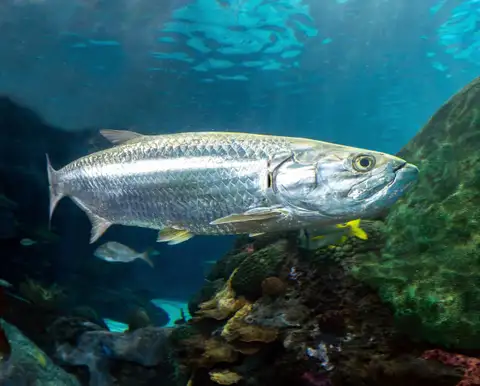
A new study has found that Atlantic tarpon, the big silver sportfish prized along the Gulf and Atlantic coasts, gather much of their food at just a few specific feeding grounds.
Those feeding areas are often hundreds of miles from where anglers eventually catch the fish. Some tarpon likely fed nearly 600 miles from the spot where they were landed.
Because the fish lean on so few feeding areas, harm to any one of them - whether from pollution, coastal building, or altered freshwater - could weaken the fishery well beyond that spot.
The work also hands managers a map of the exact places worth protecting.
Where Atlantic tarpon refuelFor a fish that can travel an entire coastline in a season, tarpon are surprisingly picky about where they refuel. They keep returning to the same rich water.
Researchers led by Lucas P. Griffin, an integrative biologist at the University of South Florida (USF), found that the animals feed in a few productive zones rather than grazing evenly across their range.
Earlier tracking had shown where these fish go. A study that followed satellite-tagged tarpon for two decades traced seasonal journeys of thousands of miles across state and national lines.
What that work could not reveal was where along those routes the fish actually ate.
Three regions stood out as the main fueling stations - South Florida, the northern Gulf of Mexico, and the coastal waters of the Mid-Atlantic.
Foraging landscapes of tarponThe team named these repeated feeding zones foraging landscapes, and compared them to the staging grounds that migrating birds use to rest and refuel between long flights.
Much of that feeding happened far from the docks where the fish were sampled.
The most likely feeding areas sat about 185 miles away on average, and ranged from roughly 25 miles to nearly 600 miles depending on the fish.
South Florida stood apart from the other zones. Tarpon from separate migratory groups all leaned on its waters, which makes the region a shared hub the wider population appears to need.
Tissue records the local chemistryFinding where a roving fish ate months earlier is hard, because the meal is long gone by the time anyone lands the animal.
To get around that, the team read two kinds of evidence written into each tarpon and its movements. The first was chemistry.
As a fish feeds, the carbon and nitrogen in its food leave stable isotopes - slightly different, non-radioactive versions of those elements - locked into its tissue, and the mix varies from place to place along the coast.
To turn that chemistry into a location, the team needed a map of how the coast's chemical signal changes from region to region.
They built one from the inshore lizardfish (Synodus foetens), a small, stay-at-home fish that lives on the seafloor across the southeastern United States.
Because it rarely moves far, its tissue records the local chemistry wherever it settles.
Fish the eat on the moveMatching a tarpon's signal to that map suggests where it fed. Blood and fin recorded different windows of time, so the two tissues told slightly different stories.
Recent meals showed up in blood, which captured roughly the previous three months and reflected feeding about 100 miles from where the fish was caught.
Fin tissue preserved about five months of feeding history and traced it farther away, averaging around 280 miles from the capture site. Five years of acoustic tracking sharpened the picture.
Underwater receivers logged tens of thousands of detections from 85 tagged fish, which let the team rule out places a given tarpon had not been and focus the chemical search on where it truly traveled.
These are best read as probable feeding regions, not exact spots.
A fish keeps eating as it moves, so each chemical signal blends many meals across a stretch of coast. The result is a landscape, not a pin on a map.
One connected coastlineThe fish do not all follow the same path.Earlier research showed that tarpon sort into two repeatable groups - one running up the Gulf toward Louisiana, the other up the Atlantic toward Virginia - with South Florida the place where the two overlap.
That structure ties distant coastlines together through single fish.
A tarpon caught in the Florida Keys may have spent the previous summer feeding in the northern Gulf, hundreds of miles away, which means faraway habitats are quietly linked by the same animals.
"These fish connect coastlines that look completely separate on a map," Griffin said.
The connection cuts both ways. Because a fish caught in one state may depend on food produced in another, damage to a single feeding ground can thin the fishery far from the harm itself.
The tarpon is already listed as a vulnerable species, and it anchors a prized catch-and-release sport fishery across the Southeast.
Why feeding grounds matterKnowing where tarpon feed still leaves open what they feed on.
"The next step is sorting out exactly what tarpon are eating in each of these hotspots," Griffin said.
The likely prey include menhaden and other small, oily schooling fish that already face heavy fishing pressure, which is why the authors want such forage species managed with big predators in mind.
The timing is difficult. A separate analysis projected some of the steepest habitat losses for migratory ocean predators off the Southeast and Mid-Atlantic as the ocean warms through the century.
What is new is the map itself. Until this study, no one had pinned down where tarpon refuel along their long migrations; now three specific regions, and the fish's reliance on a short list of them, are on the record.
That knowledge changes what protection can look like. Managers now have evidence to safeguard feeding grounds that span state and national borders.
The same approach could also uncover the hidden feeding areas of other wide-ranging marine animals that are difficult to track directly.
The study is published in the journal Movement Ecology.
-- -Like what you read? Subscribe to our newsletter for engaging articles, exclusive content, and the latest updates.
Check us out on EarthSnap, a free app brought to you by Eric Ralls and Earth.com.