
First known transmissible cancer found in catfish
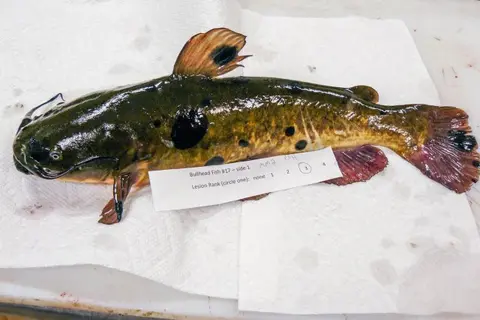
(NewsNation) -- Deep in Lake Memphremagog, sitting between the border of Vermont and Quebec, scientists from Vermont's Fish and Wildlife made a startling discovery.
Between 2012 and 2013, anglers reported finding tons of brown bullhead catfish they pulled from the lake with distinct black spots on its bodies. Once biologists got a chance to look at them, they discovered the catfish had melanoma, a type of skin cancer.
The findings, published in the scientific journal Nature, revealed 23% to 37% of the catfish sampled had melanoma lesions. Biologists pointed out the marks can sometimes be found on their gills, lips or even covering their eyes.
"It looks like black tar on the skin -- not very pretty," biologist Peter Emerson with the department told NPR. "You can tell it doesn't help the fish cause they're inside the mouth, they're on the fins."
Researchers said they believe a contagious form of cancer is spreading among the fish in the lake. They said the outbreak must have started with one fish who developed a tumor, which then shed cancer cells into the water.
Once those cells invaded the other catfish, scientists believe it jumpstarted a plague.
Researchers hypothesize the cancer came from extensive flooding in 2011 from Hurricane Irene, which led to reduced water quality of the lake due to runoff pollution.
So far, contagious tumors have only been found in a random variety of animals aside from the catfish, such as dogs, Tasmanian devils, a few different kinds of clams and some shellfish. Scientists have now been left wondering just how prevalent transmissible cancers might be, even among humans.
"This finding does reinforce the idea that transmissible cancers could emerge anywhere, including in our own species," researcher Elizabeth Murchison told The New York Times.
While scientists still research the topic, the American Cancer Society maintains cancers being spread between humans is not possible, and there's little research to indicate otherwise.