
Bottom trawling threatens centuries-old corals in the South Pacific
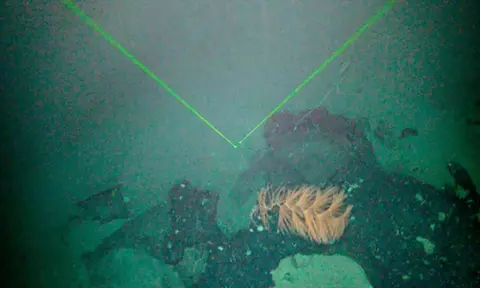
Scientists have documented century-old corals and fragile deep-sea life on a previously unexamined seamount in the South Pacific.
This newly documented site reclassifies the region as a protected ecosystem and raises immediate stakes for whether industrial fishing can return.
Footage from a deep seamount revealed dense clusters of corals, sponges, and other organisms rising from the seafloor.
Analyzing that imagery, Greenpeace Aotearoa campaigner Ellie Hooper and her team documented evidence that meets the threshold for formal protection.
Within a limited survey area, they recorded 350 individual organisms, many already more than 100 years old and some reaching significant height.
Because only a small portion of the seamount has been examined so far, the full scale of this ecosystem remains unresolved as pressure builds over its future use.
That label - a vulnerable marine ecosystem - describes a fragile habitat that recovers very slowly and can force managers to keep trawlers out.
To classify the site, scientists used a peer-reviewed framework built around standard international protection criteria.
In 94 reviewed images, 73 showed indicator animals, and 33 of those images, 45.2 percent, cleared the formal bar.
Because the survey covered only a subset of footage, the evidence still looks conservative rather than overstated.
In bottom trawling, weighted nets are dragged across the seafloor, and doors and cables can snap corals and strip away sponges.
Those animals grow as living structures, so when gear crushes them, fish and smaller invertebrates lose shelter and feeding surfaces.
Recovery drags because deep-sea corals add height slowly, and some colonies in this survey had already crossed the 100-year mark.
One pass can therefore erase growth that took decades to centuries, which is why regulators treat these habitats differently.
These communities thrive on a seamount, an underwater mountain that interrupts currents and exposes hard rock for attachment.
As water speeds up over the slope, food-rich flow reaches corals and sponges that live by filtering tiny drifting prey.
Earlier surveys had already marked the area, called Lord Howe Rise, a submerged plateau between Australia and New Zealand, as biologically rich.
What changed here was not the basic idea, but the first direct proof from this unsurveyed seamount.
The fight sharpened in 2024, when a trawler hauled up 82 pounds (37 kilograms) of coral in a single tow.
Under the current measure, one large encounter can trigger an immediate pause while scientists review the surrounding ground.
That earlier catch mattered because bycatch, animals hauled up while targeting fish, showed what the net touched, while cameras showed what survived.
With both lines of evidence now on record, reopening the area became a much steeper political choice.
New Zealand arrived at the March meeting with a proposal to raise some coral encounter thresholds.
Officials argued that the fishery is now small, with about 1,100 tons (998 metric tons) allocated and only one or two vessels active.
"We are now armed with the proof we needed that bottom trawling must be banned here," said Hooper, as Greenpeace answered with direct imagery.
The dispute now rests on whether small fishing effort truly means low risk when the animals in question took lifetimes to grow.
Age matters because old corals are not just older animals; corals are slow-built habitats that accumulate layer by layer.
Researchers estimated age from colony height, a practical method because taller deep-sea corals usually reflect many years of growth.
Some colonies stood well above the 100-year threshold lines used in the analysis, especially among bamboo, black, and stony corals.
That long clock is the real stake, since destruction happens in minutes but rebuilding can outrun human planning cycles.
One surveyed seamount cannot stand in for the whole plateau, and the team sampled only part of one closure area.
Yet that limit cuts both ways, because a small sample already found dense, old assemblages where trawl gear had worked nearby.
The full expedition report is expected to reach the scientific committee in September 2026, when the paused encounter gets reviewed again.
More camera time could widen the map, but it is unlikely to make this candidate site look less sensitive.
A permanent closure would not rebuild the damaged corals, but it would stop new gear from grinding through the same habitat.
It would also give managers a cleaner test of recovery, because fewer fresh scars make future surveys easier to interpret.
For readers far from the South Pacific, that may sound remote, yet these are rules for water belonging to everyone.
What happens on one ridge can therefore tell regulators whether high-seas promises work when old life and active nets collide.
The finding confirms that a coral community exists in an area where fishing still seeks access.
If regulators treat that proof seriously, one small seamount may become a test of whether deep-sea protection rules mean anything at all.
-- -Like what you read? Subscribe to our newsletter for engaging articles, exclusive content, and the latest updates.