
A new early warning system for river fish during heatwaves
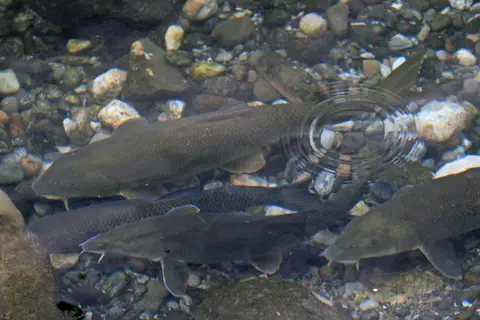
The new tool predicts, up to three weeks in advance, how at-risk fish populations are from heat across Switzerland. The predictions are based on three parameters: water temperature forecasts, fish physiology and species distribution. WSL's hydrological forecasting group developed the water temperature forecasts. "Our machine-learning model, trained on data from the past 10 years, uses the latest water temperature observations and weather forecasts to predict river temperatures", explains Ryan Padrón Flasher, one of the group's members.
Not all fish are equally sensitive to heat. Searching through published data, the authors gathered information on the temperature limits of 59 fish species found in Swiss rivers. This is the temperature at which their ability to swim, and therefore to escape from dangerous conditions, is impaired. The authors found non-native fish species to have a temperature tolerance 1.4°C higher than native species on average. The bighead carp (Hypophthalmichthys nobilis) held the highest tolerance of 32.3°C, while the burbot (Lota lota) was the least tolerant, with 24.1°C.
Finally, as fish species are unevenly present across Switzerland, including information on their distribution makes the forecasts location specific. "It's a constant compromise between the complexity and quality of the model", explains Camille Albouy. "As the idea was to develop a map of risk for the whole of Switzerland, based on the best climate predictions, we had to keep it simple and focus on what matters for management."
With the help of hindsightTo evaluate the forecasts, the scientists applied their tool on data from summer 2018, when around three tonnes of river fish died in Switzerland. "We wanted to see how well we could retrospectively predict the observed fish mortality", says Camille Albouy. However, this proved more challenging than expected. "Data on fish mortality are limited," he clarifies, "so we reached out to practitioners to see if their observations matched our predictions."